
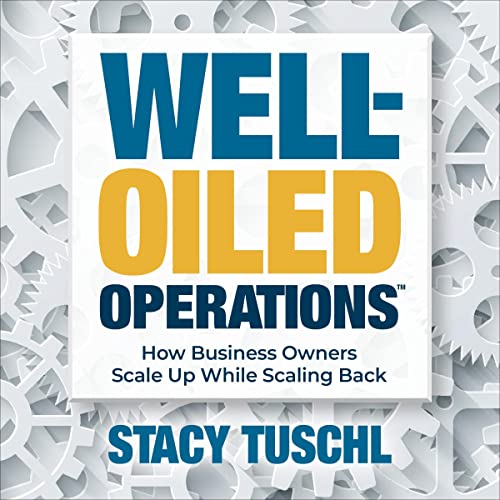
How Business Owners Scale Up While Scaling Back
By Marc Bowker
I’ve been running Alter Ego Comics in Lima, Ohio since 2003. For a long time, I was the
business. I did everything. I was the buyer, the marketer, the sales team, the
bookkeeper, the social media manager, and yes, occasionally the janitor. Sound
familiar?
That’s actually how Stacy Tuschl opens Well-Oiled Operations, and when I read that
line, I felt genuinely seen. She writes about being the dance teacher, the marketing
manager, the finance department, and the HR coordinator all at once. Different industry,
same chaos.
Here’s what I know from personal experience: doing everything yourself isn’t just
inefficient. It’s a path to burnout. I learned that the hard way in 2016. This book is
essentially a manual for preventing that.
What the Book Is About
Tuschl built a dance studio from scratch and eventually grew it into a multi-location
business. The core argument of Well-Oiled Operations is simple: your job as a business
owner is to be the visionary, not the doer. Your goal is to build a business that runs
without you constantly running it.
She lays out a practical framework built around five areas: team, systems, leadership,
communication, and what she calls leverage. Throughout the book, she shares specific
tactics she has used, not just theory. Every chapter feels like a conversation with
someone who has actually been in the trenches.
What Hit Me the Hardest
“It’s not Susie; it’s your leadership skills.”
If you’ve ever blamed an employee for something that went sideways, that line is going
to land. And it should. Tuschl’s argument is that most team problems trace back to a
lack of clarity from the top. Your people can’t win if they don’t know what winning looks
like. She pushes you to define KPIs for every position, give each team member three to
five measurable metrics each week, and actually share that information with them.
She also uses a framework called GWC: Do they get it? Do they want it? Are they
capable? Before you assume someone is a problem employee, you owe it to them to
honestly work through all three. In my experience, most performance issues come down
to the first one. People don’t get it because we haven’t made it clear.
I’m not a perfect leader, and this section gave me some things to think about and tools
to implement.
The Systems Chapter Changed How I Think
Tuschl is direct: if you don’t have standard operating procedures, you will always
struggle. Not might. Will.
What I appreciate is that she doesn’t make this overwhelming. She doesn’t say yo
need to systemize everything. She says start with client delivery and fulfillment. Make
sure every customer gets the same experience every single time. Then work outward
from there.
Her process is simple: assign it, document it, test it, implement it. And her tip about
using video walkthroughs instead of written instructions is genuinely smart. It’s much
harder to skip a step when you’re actually doing the thing on camera. Have someone
unfamiliar with the task try to follow your documentation. If they can’t, it’s not done yet.
The Communication Section Is Uncomfortable in the Best Way
Tuschl talks about how checking your email constantly actually trains people to expect
fast responses, which creates more emails and more interruptions. The more you
check, the more you get.
She recommends checking email once or twice a day, max, and using an
autoresponder to reset expectations. She batches all her appointments on one day
each week so her calendar link only shows those available slots. These aren’t
revolutionary ideas, but seeing them laid out so plainly made me realize how much of
my own reactive behavior I’ve been passing off as “good customer service.”
As a small business owner who has been conditioned to always be available, this
section challenged me. But it also makes complete sense. We can’t do our best thinking
when we’re constantly reacting. That’s true whether you run a comic shop, a salon, a
law office, or a landscaping company.
The Meetings Conversation
Tuschl’s take on meetings is worth the price of the book by itself. She argues that most
meetings exist for three reasons: to make sure priorities are aligned, to check progress
toward goals, and to find out where people need support. That’s it. If your meeting
doesn’t serve one of those purposes, it probably shouldn’t exist.
She also makes a point that more frequent meetings don’t mean faster results. If you
meet too often, you’ll just keep hearing “I’m still working on that” because people
haven’t had time to actually implement anything. Give your team room to execute. And
never leave a meeting without clarity on who does what by when.
Who Should Read This Book
Honestly? Every small business owner I know. Especially if you’ve ever felt like the
business would fall apart without you. Especially if you’ve ever thought “it’s just easier if
I do it myself.” Especially if you’re exhausted.
Tuschl closes with a challenge to focus on one area each month over five months: time,
money, team, best sellers, and best clients. Imagine what your business could look like
five months from now if you actually did that. The progress compounds fast when you’re
intentional about it.
The book is practical, honest, and a little uncomfortable in exactly the right ways. It’s the
kind of read that makes you want to look at your own operation with fresh eyes. I came
away with a list of things to change and a renewed sense that it is actually possible to
build something that doesn’t require you to be everywhere at once.
We didn’t open our businesses to become prisoners of them. Well-Oiled Operations is a
solid reminder of that, and a clear path forward.
Rating: 5 out of 5 stars
Marc Bowker | Owner, Alter Ego Comics | Lima, Ohio
